
News
A qualitative study of social support and capital among individuals receiving an abortion in Georgia
Dr. Mosely and her team conducted in-depth interviews with post-abortion patients and found that:

Gender, Parenting Status, and the Academic Productivity of Pediatricians During the COVID-19 Pandemic
Dr. Kazmerski and her team found that the Covid19 pandemic impacted men and women physicians differently. Women physician parents were more likely to report decreased academic productivity than men with children, often citing unreliable childcare.
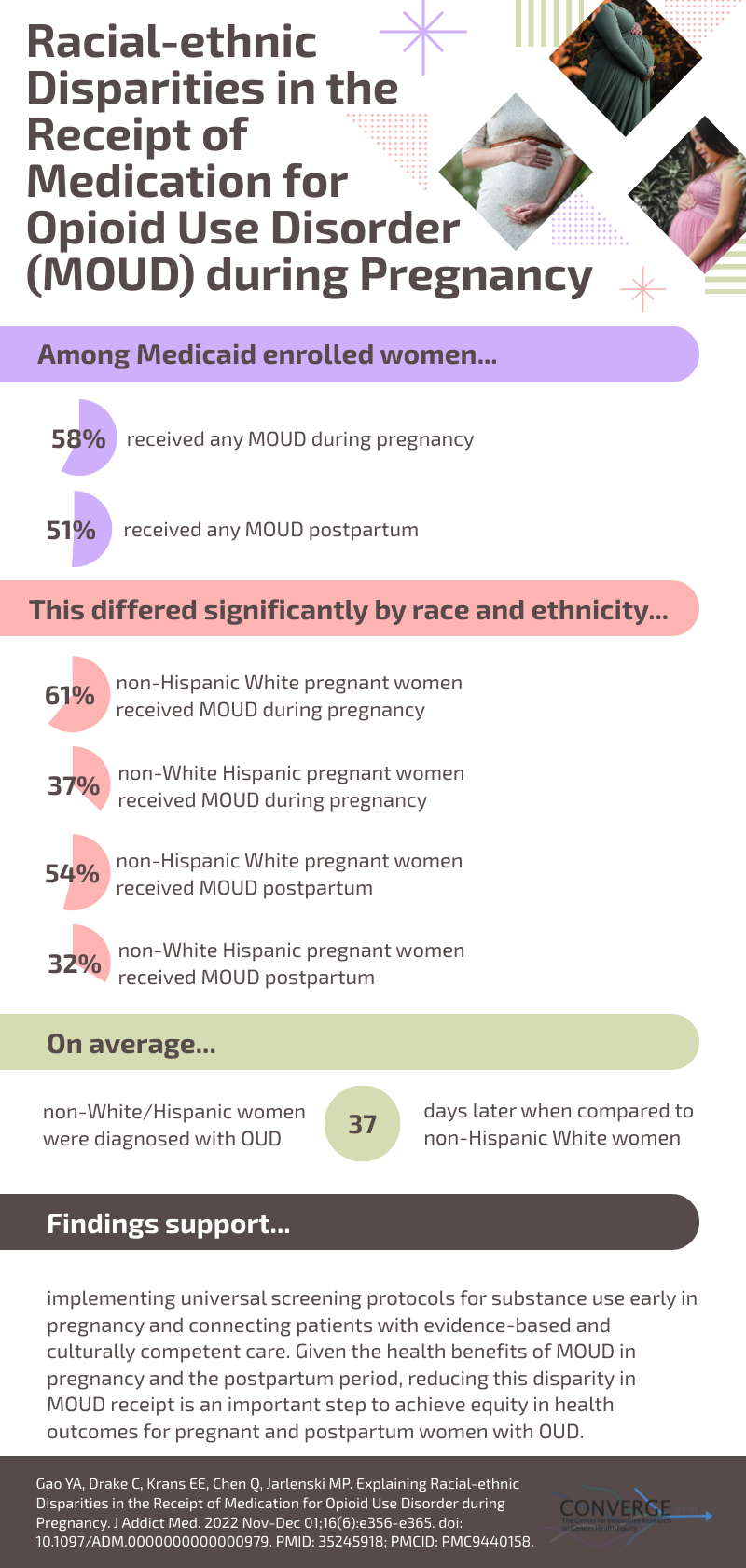
Explaining Racial-ethnic Disparities in the Receipt of Medication for Opioid Use Disorder During Pregnancy
Alice Gao, Dr. Liz Krans, and Dr. Marian Jarlenski found that later diagnosis of opioid use disorder (OUD) in pregnancy among non-White/Hispanic women partially explains the disparities in medication for opioid use disorder (MOUD) receipt in this population. Universal substance use screening earlier in pregnancy, combined with connecting patients to evidence-based and culturally competent care, is an approach that could close the observed racial-ethnic disparity in MOUD receipt.

Visualizing Mental Health Through the Lens of Pittsburgh Youth
Faculty member Dr. Sara Baumann used collaborative filmmaking to understand the mental health stressors and supports in the lives of youth during the Covid19 pandemic.

Association of cannabis use with nausea and vomiting of pregnancy
Dr. Jarlenski and her team evaluated whether cannabis use was associated with nausea and vomiting in early pregnancy, and found that higher THC levels were associated with increased odds of moderate-to-severe nausea (20.7% THC detected vs 15.5% in THC not detected).

Stress, social support, and racial differences: Dominant drivers of exclusive breastfeeding
Findings by Drs. Dara Mendez, Jill Demirci, and Esa Davis show that:
- Childbearing people who reported higher perceived stress were less likely to breastfeed exclusively
- Perceived social support moderated perceived stress, thereby increasing the likelihood of exclusive breastfeeding
- Received social support did not moderate perceived stress; however, it directly increased the likelihood of exclusive breastfeeding
- Overall, Black childbearing people in our study were less likely to exclusively breastfeed

Increasing access to immediate postpartum contraceptive implants among patients with opioid use disorder
Drs. Elizabeth Krans and Beatrice Chen evaluated the effects of increased access to immediate postpartum contraceptive implants on repeat pregnancy and contraceptive use rates among patients with opioid use disorder.

Cervical Cancer Prevention in El Salvador
This Cervical Cancer Awareness Month we are highlighting Dr. Miriam Cremer's analysis on the improving prevention tactics, the impacts of Covid 19, and the potential solutions that can help eliminate cervical cancer in El Salvador.

Focus groups with rheumatologists and rheumatology advanced practice providers on sexual and reproductive health care
Dr. Traci Kazmerski, Olivia Stransky, Dr. Sonya Borrero, Dr. Megan Hamm, and Dr. Mehret Birru Talabi conducted focus groups with rheumatologists and rheumatology advanced practice providers to elicit their solutions to overcoming barriers to sexual and reproductive health care.

Dr. Jackie Ellison announced as committee member for the Society of Family Planning
The Society of Family Planning and Society of Family Planning Research Fund have announced their newest Committee members, including faculty member Dr. Jackie Ellison. In this role, Dr. Ellison will help advance the vision of just and equitable abortion and contraception informed by science through their work on the Annual Meeting Committee.

Understanding Postpartum Anxiety
According to Drs. Jill Demirci and Michele Levine recent research, detection of postpartum anxiety in clinical settings can be improved through addition of the Postpartum Specific Anxiety Scale (PSAS) in routine screening. Timing of anxiety assessment should be considered between 6 to 8 weeks after birth.
Navigating the Changing Abortion Landscape: Implications for Midwives and Midwifery Practice
Abortion bans challenge midwives’ ability to practice reproductive justice and honor the health care needs and preferences of every individual. Dr. Nancy Niemczyk and her colleagues wrote about the changing landscape for midwives who provide abortion post-Dobbs decision.

A qualitative, community-led medication abortion study with Black and Latinx People in Georgia
Traditional family planning research has excluded Black and Latinx leaders, and little is known about medication abortion among racial/ethnic minorities, although it is an increasingly vital reproductive health service, particularly after the fall of Roe v. Wade. Findings from Dr.

Web guides for youth with epilepsy
New web guides have been developed for youth with epilepsy. These guides were created collaboratively between people with epilepsy, multidisciplinary physicians, and the Center for Young Women’s Health.
These guides cover topics such as:

Health Care and Adoption Service Experiences of People Who Placed Children for Adoption During Adolescence: A Qualitative Study
Individuals who chose adoption after adolescent pregnancy described positive and negative encounters with health care and adoption professionals that could serve as targets to improve the overall care experience for this population.